

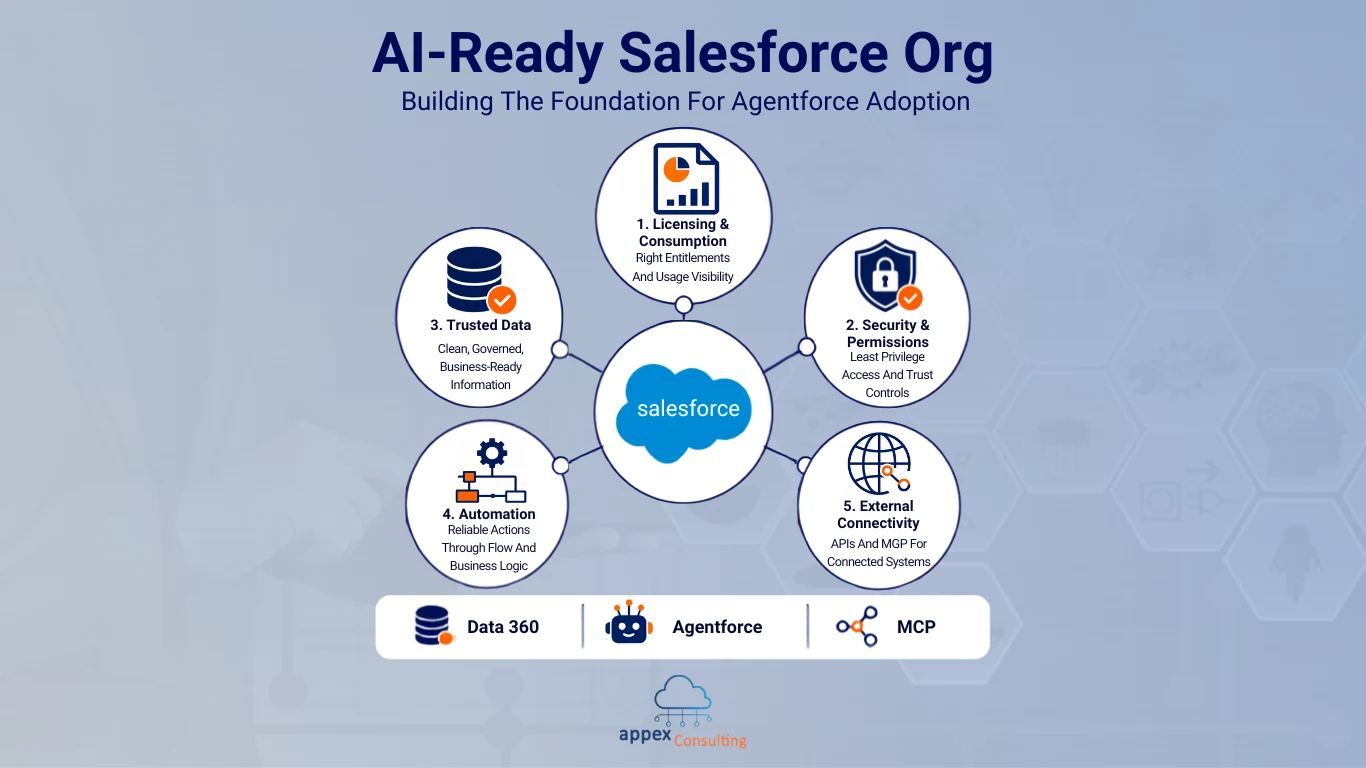
Building an Agentforce agent is only one part of introducing AI into Salesforce. Before an organisation starts connecting agents to customers, employees and business processes, it needs to know whether the Salesforce environment underneath them is ready to support that level of automation.
That preparation covers several areas at once. Licensing determines which capabilities are available, permissions control what agents can access, data quality affects the context they receive, and existing automation determines whether they can perform actions reliably. Data 360 and technologies such as Model Context Protocol (MCP) add further possibilities, but they also introduce architectural decisions that should be made before the implementation grows.
An AI-ready Salesforce org therefore starts with the platform around the agent. Reviewing these foundations early can prevent a successful proof of concept from becoming difficult to govern or scale later.
Check Licensing And Platform Access First
Agentforce licensing is not identical for every implementation. Salesforce supports Agentforce across Enterprise, Performance, Unlimited and Developer Editions, while the required add-on licences vary depending on the type of agent and the Salesforce products involved.
This matters because an Agentforce project often depends on capabilities outside Agentforce itself. A Service or Field Service scenario may require the relevant product functionality and permissions, while other implementations may depend on Data 360, Prompt Builder or specialised Agentforce features.
Consumption should also be understood before usage increases. Salesforce uses Flex Credits for a range of Agentforce and embedded AI activities, with usage visible through Digital Wallet, allowing teams to monitor consumption as agents move from development into production.
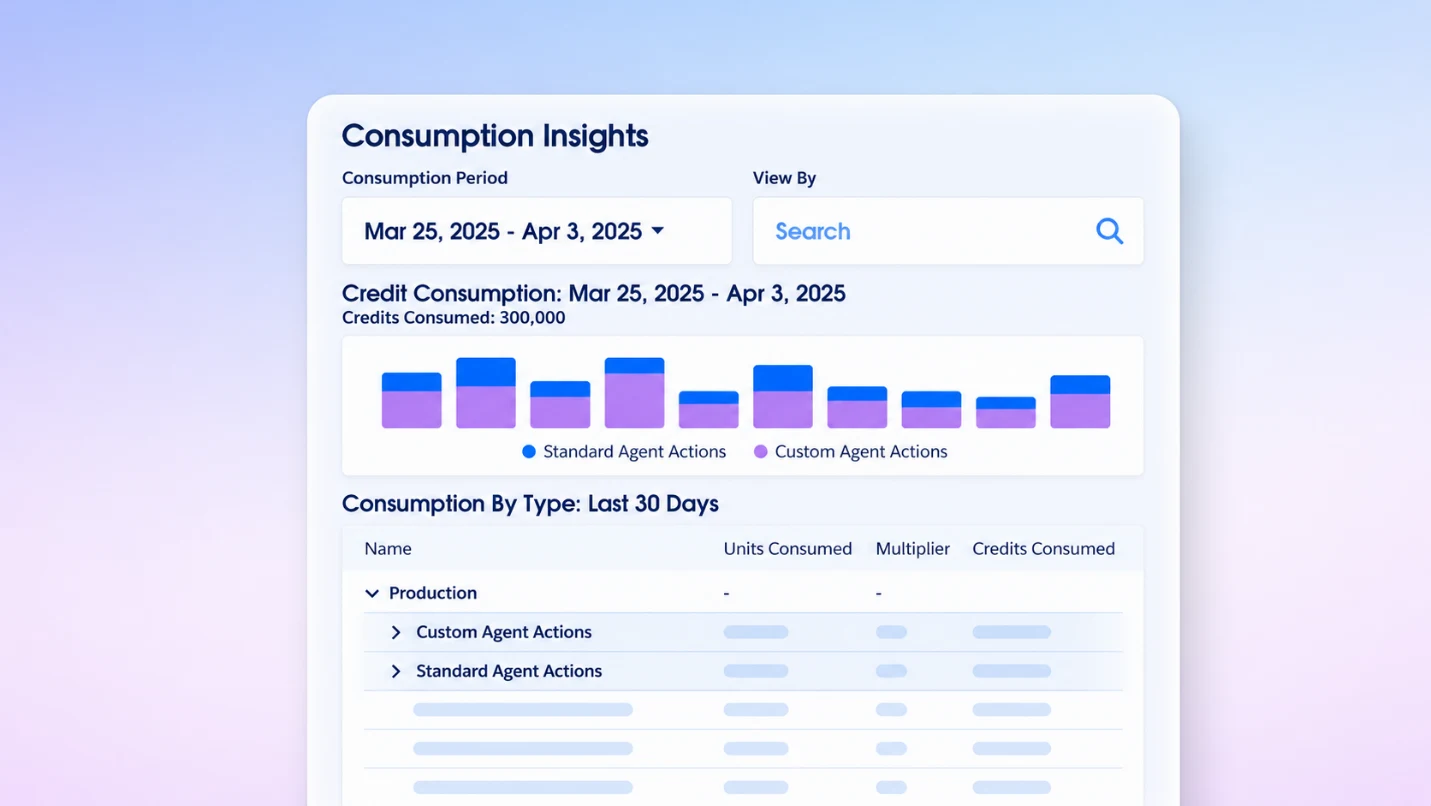
The licensing review should therefore happen while the solution is being designed. It is much easier to adjust an architecture before development than to discover later that an important action, data capability or volume of usage requires an entitlement that was not included in the original plan.
Review Security And Agent Access
AI introduces another way for users and systems to interact with Salesforce data, which makes the existing security model especially important. Object permissions, field-level security, sharing rules and permission sets should already reflect the access that people and automated processes genuinely need.
Salesforce adds protections through the Einstein Trust Layer, including secure grounding, sensitive-data masking, toxicity detection, audit capabilities and zero-data-retention agreements with supported third-party model providers. These controls provide an important security layer, but they work alongside the organisation's existing Salesforce access model.
Customer-facing Service agents require particular attention because they can operate without a logged-in Salesforce user representing the customer. Salesforce uses a dedicated agent user for these scenarios, and recommends expanding its access according to the principle of least privilege rather than giving the agent broad access to Salesforce data.
A permissions review before deployment can therefore prevent two different problems: an agent that cannot access the information required to complete its job, or an agent that has access to information it should never expose or modify.
Get Core Salesforce Data In Shape
Agentforce relies on the information available to it, so existing data problems quickly become AI problems. Duplicate customer records, missing values, inconsistent statuses and outdated information can all affect the context an agent receives and the decisions it makes.
The useful starting point is not an organisation-wide data-cleaning programme. Teams should identify the data required for the processes they intend to support with AI, confirm where that information comes from and understand which system is responsible for maintaining it.
This becomes especially important when several systems contain different versions of the same information. A CRM may contain contact and opportunity data while an ERP holds transaction history, an ecommerce platform contains purchases and a service system contains support activity.
Before those sources are made available to an agent, the organisation should understand how they relate to each other and which information can be trusted. Adding more data does not automatically provide better context if the relationships and ownership behind it are unclear.
Decide Where Data 360 Is Needed
Data 360 becomes relevant when the information required by an AI use case extends beyond a single set of Salesforce records. It can ingest information from different sources, map it into Salesforce's data model and make that context available to Salesforce applications and AI capabilities.
Identity Resolution can then connect source profiles that refer to the same person or account by applying matching and reconciliation rules. Salesforce describes the resulting unified profile as a system of reference rather than a traditional golden record, because the underlying source records remain available and Identity Resolution does not simply overwrite them with one winning value.
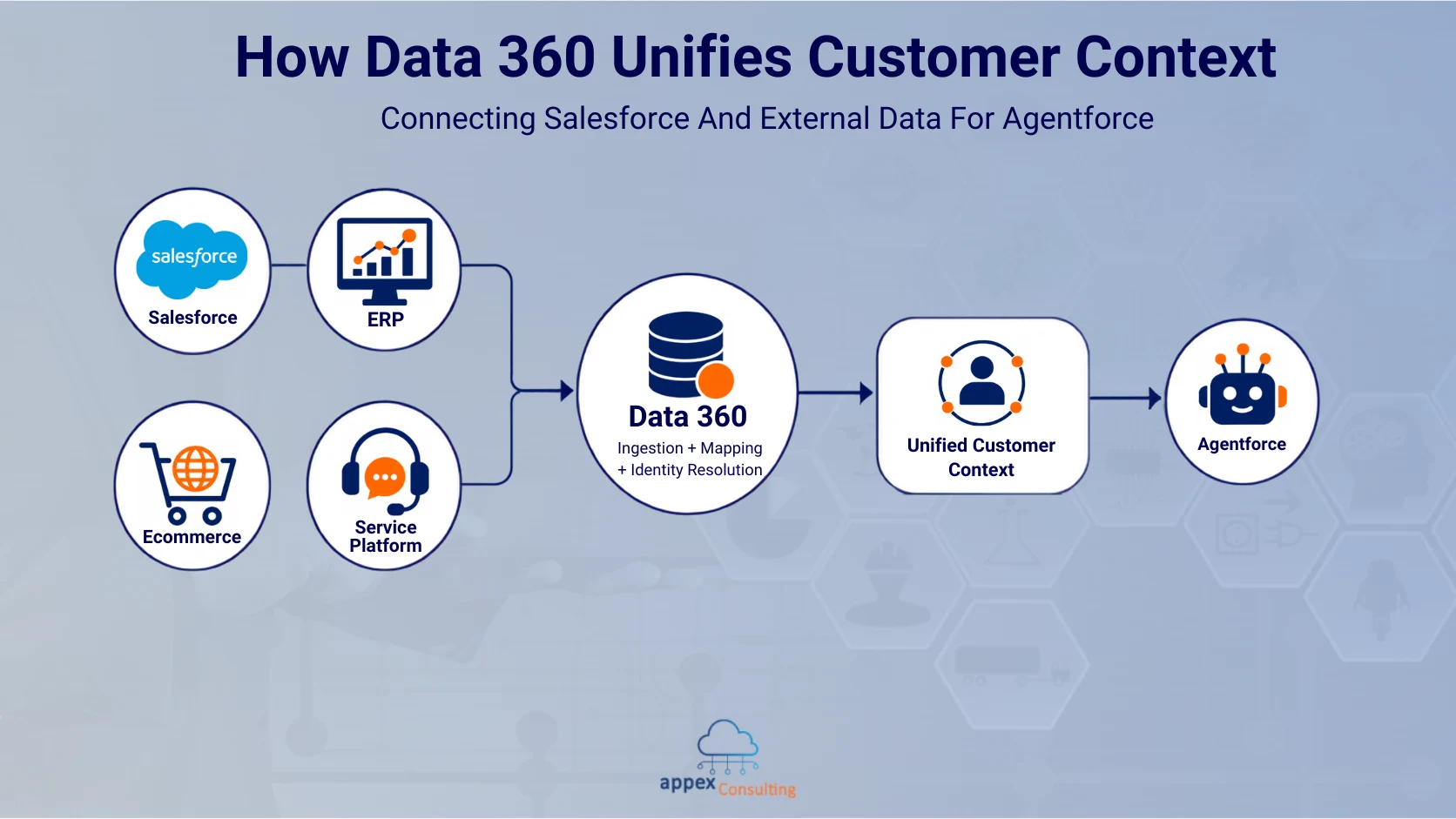
For Agentforce, this can provide a much richer operating context. A service agent could work with CRM records together with purchase history, while another use case might combine customer information with product, engagement or operational data from external systems.
Data 360 should still be introduced according to the requirements of the architecture. An agent using reliable Salesforce records for a contained internal process may not need extensive data unification, whereas an agent expected to work across several customer-data sources is likely to depend much more heavily on it.
Prepare Knowledge For Reliable Grounding
Many Agentforce use cases depend on information that does not exist in structured CRM fields. Policies, manuals, product documentation, support procedures and other business content often provide the knowledge an agent needs to answer questions accurately.
Agentforce Data Libraries provide a way to make Salesforce Knowledge, uploaded documents and supported retrievers available for grounding. Creating a Data Library automatically uses Data 360 components such as data streams, search indexes and retrievers, and Salesforce requires Data 360 to be configured for this capability. Data Libraries also consume Data 360 credits.
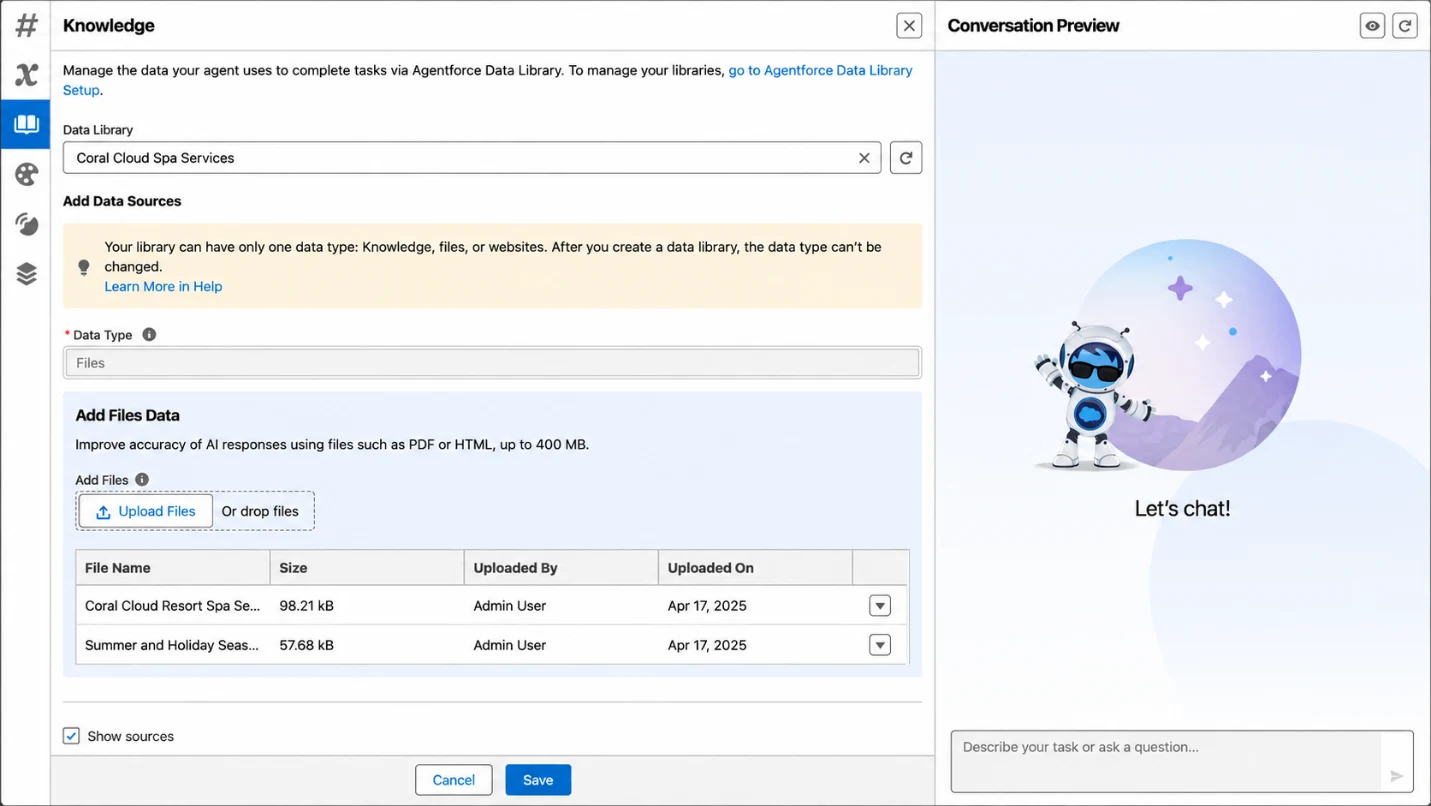
This makes knowledge preparation both a technical and a governance task. Documents should be current, duplicate or conflicting versions should be addressed, and important content should have an owner responsible for keeping it accurate.
A well-configured retriever cannot compensate for an unreliable source library. If employees cannot determine which policy or document is current, an AI agent will face the same ambiguity when it searches that information.
Make Existing Automation Agent-Ready
Agents often create the most value when they can complete work inside Salesforce rather than only provide information. That means existing Flows, Apex, validation rules and integrations become part of the Agentforce architecture.
Before an agent starts invoking those processes, teams should confirm that the underlying automation behaves consistently and has clearly defined inputs and outcomes. A Flow designed to update an appointment, create a service request or modify an Opportunity should produce predictable results regardless of whether it is triggered by a user interface or exposed to an agent.
Clear boundaries around actions also reduce unnecessary risk. An agent can collect information and decide when an action is appropriate, while Salesforce automation continues to enforce validation, business rules and record updates.
This separation keeps important logic in components that administrators and developers can test independently. It also makes future changes easier to manage because a business rule can be updated in the underlying automation without redesigning the entire conversational experience.
Plan External Connectivity And MCP
Salesforce rarely contains every system an AI agent may need. ERP platforms, finance systems, product databases and specialised applications often hold information or functionality that becomes relevant during an Agentforce process.
Standard APIs and existing integration platforms remain important options for connecting these systems. MCP adds another approach by providing a common protocol through which AI applications can access external tools and services.
Salesforce introduced MCP for Agentforce with an MCP client built into the platform. Third-party MCP servers can be registered through Agentforce Registry, approved server tools can be allowlisted and exposed as agent actions, and Agentforce Gateway can apply policies governing how those tools are used.
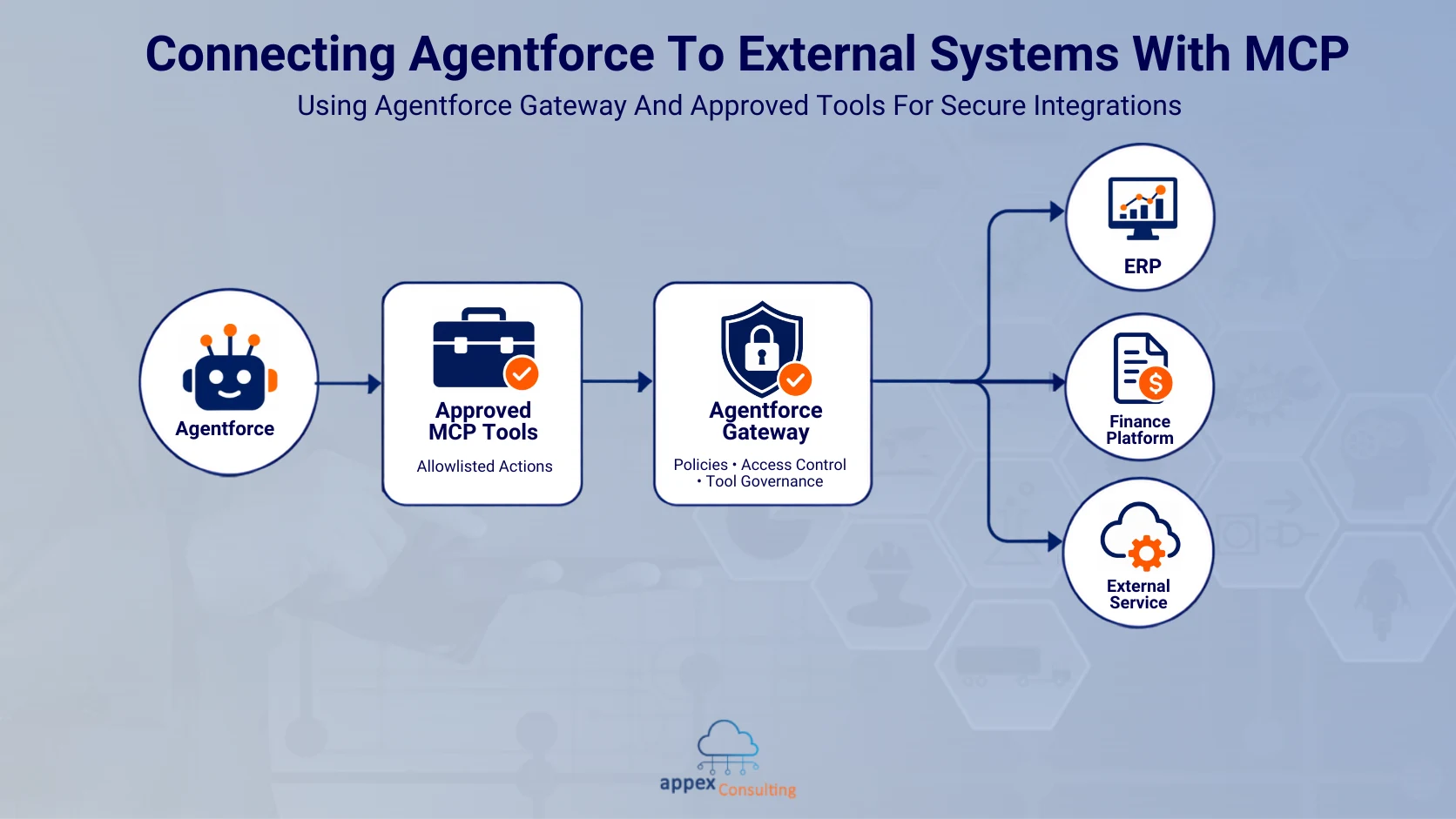
This can make external capabilities easier to expose to an agent, particularly as more platforms adopt MCP. The architectural responsibilities remain familiar, however, because authentication, permissions, data exposure, ownership and failure handling still need to be designed before an external tool is trusted with business operations.
MCP is therefore most useful when a genuine external-system requirement exists. Organisations do not need to introduce it simply because they are adopting Agentforce, but they should understand where it could fit into their integration strategy as agent use cases become more connected.
Put Governance And Monitoring In Place Early
Once agents have access to business data and actions, ownership needs to extend beyond the initial configuration. Teams should know who is responsible for permissions, data sources, knowledge content, automations and external tools as those components change over time.
Consumption also becomes part of day-to-day governance. Digital Wallet gives organisations visibility into Agentforce usage, while the wider Salesforce platform provides controls for permissions, auditing and the components supporting agent behaviour.
The same principle applies to changes in the underlying Salesforce environment. A revised Flow, new permission set or updated knowledge source can affect an agent even when the agent configuration itself has not changed, so AI governance should be connected to the organisation's existing Salesforce release and change-management processes.
This is particularly important as the number of agents grows. Governance that is manageable for one proof of concept can become difficult to retrofit once several teams are building agents against the same data, automation and external services.
What An AI-Ready Org Looks Like
An organisation is in a much stronger position to adopt Agentforce when it understands its licensing and expected consumption, has a controlled permissions model and knows which data sources its AI use cases will depend on. It should also have a clear view of whether Data 360 is needed for unified context and whether unstructured knowledge is sufficiently governed to be used for grounding.
The technical foundation should include reliable Salesforce automation for the actions agents may perform and an integration strategy for information or tools outside Salesforce. Where MCP is appropriate, its servers, tools and access policies should be managed with the same care as other enterprise integrations.
These foundations do not all need to reach enterprise-wide perfection before an organisation experiments with AI. They do need to be understood well enough that the team knows which areas are ready, which require improvement and what will need to change as Agentforce adoption expands.
AI Readiness Starts With The Salesforce Foundation
Preparing for Agentforce often exposes issues that were already limiting the Salesforce environment, from duplicate data and unclear access to fragile automation and disconnected systems. Resolving those issues strengthens the AI implementation while also improving the platform employees already use every day.
At Appex, we help organisations assess and strengthen their Salesforce architecture, data, security and integration landscape before introducing Agentforce, through services covering implementation, consulting, org. optimization and managed services. From establishing the right Salesforce foundation and improving existing environments to supporting them as they evolve, our work helps prepare the platform for capabilities such as Data 360, knowledge grounding, automation and MCP connectivity. The objective is to build an environment where AI use cases can grow without creating unnecessary complexity later.